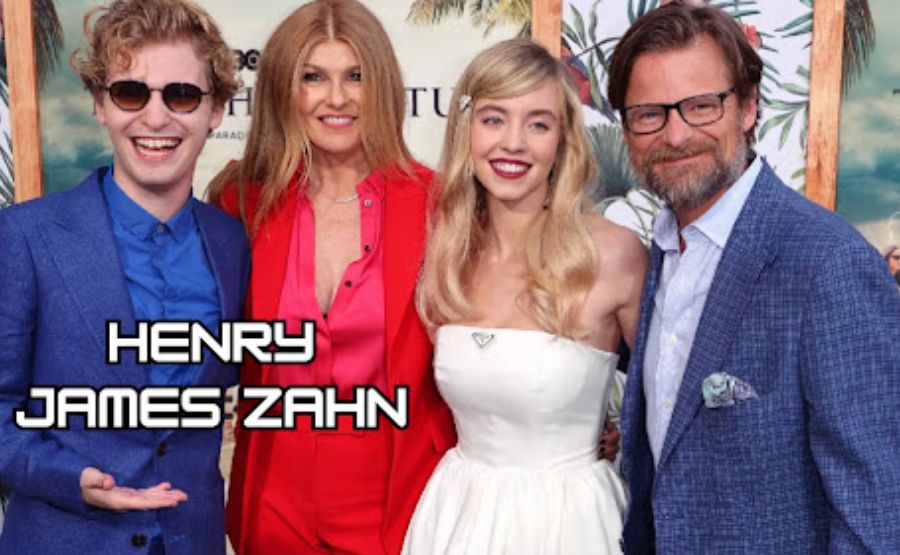
Henry James Zahn: A Portrait of Deliberate Obscurity
In an era that rewards relentless self-promotion, Henry James Zahn has built something quietly countercultural — a creative identity rooted not in who his father is, but in what he chooses to see through a lens.
Quick Facts
| Detail | Information |
| Full Name | Henry James Zahn |
| Date of Birth | April 3, 2000 |
| Place of Birth | New York City, New York, USA |
| Nationality | American |
| Age (as of 2026) | 26 years old |
| Zodiac Sign | Aries |
| Primary Occupation | Photographer |
| Education | University of Southern California (USC), graduated 2022 |
| Father | Steve Zahn (actor, born November 13, 1967, Marshall, Minnesota) |
| Mother | Robyn Peterman Zahn (author and former actress) |
| Maternal Grandfather | John Peterman, founder of the J. Peterman Company |
| Sibling | Audrey Clair Zahn (born April 25, 2002; studies music and theatre at Baldwin Wallace University) |
| Family Home | 36-acre horse farm near Georgetown/Lexington, Kentucky |
| Known For | Portrait, street, fashion, and landscape photography; deliberate privacy |
| Notable Milestone | Student exhibition at USC earned critical attention from art community (c. 2021–2022) |
| Social Media | Largely absent from public platforms |
Origins: A City Born into Stories
Henry James Zahn entered the world on April 3, 2000, in New York City. It was a fitting origin for a child who would grow up inside creative tension — the city’s restless energy on one side, and the quiet of a Kentucky horse farm on the other.
His father, Steve Zahn, was already a recognized face in American cinema. Born in Marshall, Minnesota in 1967, Steve had trained at the American Repertory Theatre in Cambridge and arrived in New York expecting to play leading men. Instead, he became something more durable: one of the finest character actors of his generation. His mother, Robyn Peterman Zahn, came from equally vivid stock. Daughter of John Peterman — the Kentucky entrepreneur whose catalog company became so culturally embedded it spawned a recurring Seinfeld character — Robyn had worked as a stage actress before reinventing herself as a bestselling author of paranormal romance and contemporary fiction. Henry was, in the most literal sense, born to storytellers.
The family’s early years unfolded in stages. Steve and Robyn had met during a 1991 national tour of Bye Bye Birdie and married three years later in 1994. They lived in New York City, then kept a Pennsylvania cabin, then a farm in New Jersey near the Delaware Water Gap. By the time Henry arrived, the couple had already developed a preference for living outside the traditional Hollywood orbit. That instinct would eventually shape their son’s entire worldview.
See also ”Natalie Oglesby Skalla: Choosing Silence in the House of Sinatra”
The Kentucky Years: A Childhood Built on the Land
In 2004, when Henry was four years old, the Zahn family made a decision that would quietly reframe everything. Steve had long been encouraging Robyn to move back to her hometown. She relented once children entered the picture. They relocated to a 36-acre horse farm near Georgetown, Kentucky, just outside Lexington — and they never looked back.
What followed was a childhood of genuine rarity for the offspring of a working Hollywood actor. Henry and his younger sister Audrey grew up alongside horses, goats, sheep, dogs, and cats. Their father rose at 5:30 every morning to tend animals. Their mother wrote into the small hours of the night. The rhythm of the household ran on farm time, not studio time.
Steve Zahn has spoken openly about this choice in interviews. He described the daily routine of mowing pastures from a tractor as something approaching forced meditation. He spoke of his son reaching adulthood without a social media presence, attributing it to a life full enough that screens didn’t fill a vacuum. Steve and Robyn also ran a local community theater near their farm, bringing theatrical life into the community rather than retreating entirely from the arts.
Henry absorbed all of it. The wide open fields, the early mornings, the smell of livestock and turned soil — and simultaneously, the nightly hum of his mother’s creative work, the film industry conversations that drifted through the household, the understanding that storytelling was simply what people in his family did. He had a front-row seat to two distinct creative philosophies: his father’s physical, improvisational, deeply social approach to performance, and his mother’s solitary, disciplined, interior practice of writing. Neither path would become his. He would find a third one.
The Education of an Eye: High School Through USC
Precise details about Henry’s pre-university schooling remain private. What the record does establish is that he attended high school in New York and that his earliest experimentation with photography began during those years. The medium suited something in his temperament — it was solitary but communicative, disciplined but open to accident, grounded in the physical world he had grown up observing on the farm.
After graduating from high school, Henry enrolled at the University of Southern California, choosing an institution with deep institutional roots in arts, media, and visual culture. USC’s film and fine arts programs place students inside Los Angeles’s creative ecosystem while still maintaining rigorous academic structures. For a young photographer shaped by Kentucky’s open landscapes and New York’s crowded streets, the move to Los Angeles represented a third kind of geography to absorb.
At USC, Henry pursued photography with both technical rigor and conceptual seriousness. The curriculum demanded fluency across composition, lighting, framing, and visual narrative. He did not simply learn to operate a camera well. He learned to think in images — to understand what a photograph argues, what it withholds, what it transforms. During his time at USC, a student project he exhibited at a campus gallery drew positive notice from critics and art enthusiasts, marking an early signal that his work could stand without the scaffolding of his family name. He graduated in 2022.
The Craft: Photography as a Language of Restraint
Since leaving USC, Henry James Zahn has built his professional practice with deliberate patience. His portfolio spans portrait, street, fashion, and landscape photography. Across all these genres, observers note a consistent thread: emotional restraint, preference for natural light, avoidance of heavy digital manipulation, and a tendency to find meaning in ordinary or overlooked moments.
These are not accidents of technique. They reflect a cultivated philosophy. In an age when photography has been democratized to the point of ubiquity — when billions of images are produced daily and algorithmic platforms reward shock and saturation — Henry’s work leans in the opposite direction. His images, by all available accounts, require patience from the viewer. They reward looking twice.
The cinematic influence of his upbringing surfaces in this work, but it doesn’t dominate it. Growing up watching his father prepare for roles, understanding how film constructs emotion through image and timing, likely gave Henry a sophisticated early education in visual storytelling. Yet his photography doesn’t imitate cinema. It is more intimate, more still. It asks different questions.
He has exhibited in small gallery spaces across New York and Los Angeles — choices that themselves signal something about his artistic values. Large commercial galleries reward market cachet and provenance. Smaller, more intimate spaces reward the work itself. Henry has consistently chosen the latter.
He has also built a client base that includes models, fashion brands, and commercial commissions. This side of his practice is less publicly documented — in keeping with his general preference for privacy — but it represents the practical infrastructure of a sustainable creative career built on merit rather than name recognition.
The Family Architecture: Pressure and Support
To understand Henry James Zahn fully, one must understand the household he came from — not as a burden or as an advantage, but as a specific kind of atmosphere.
Steve Zahn spent three decades as a working character actor navigating the particular psychology of that role. He was never the lead. He was almost always the element that made the film crackle. His career required the sustained discipline of showing up brilliantly in service of other people’s stories. There is something instructive in that model for a son who chose photography — another craft where the practitioner disappears behind the work, where the artist’s ego must serve the image rather than dominate it.
Robyn Peterman Zahn brought her own distinct energy to the household. A former actress who rebuilt herself entirely as a writer after moving to Kentucky, she modeled creative reinvention without apology. She worked obsessive hours. She built a New York Times bestselling career in a genre — paranormal romance — that the literary establishment underestimates. In a 2014 interview with HerKentucky, she described her family as “fantastically nutty” and “loaded with actors, screenwriters and maverick entrepreneurs.” The pride in that description is unmistakable.
Henry’s sister Audrey Clair Zahn, born in April 2002, pursued performance more directly. She studied music and theatre at Baldwin Wallace University and appeared in the television series An Uncandid Portrait. The sibling bond between Henry and Audrey was forged on the farm, shaped by years of creative play and shared removal from Hollywood’s machinery.
What emerges from all available accounts is a family that provided genuine creative freedom without demanding any particular form it should take. Henry was not steered toward acting. He was not discouraged from photography. He was given space, stability, and enough physical and intellectual engagement that he could discover what he actually wanted.
Privacy as Practice: A Choice, Not a Default
One of the most striking things about Henry James Zahn, at 26, is the degree to which his privacy appears to be an active decision rather than a passive consequence of limited fame. He seldom ever posts on social media. He does not court press. He does not appear at industry events or use his father’s connections as a publicity lever.
His father has made occasional public comments that illuminate the deliberateness of this. Steve Zahn remarked in an interview that his son reached his twenties without social media — not because of parental prohibition, but because the farm life filled the space that screens might otherwise have occupied. The implication is worth sitting with: Henry grew up with things to do, and those things were more interesting than performing a life online.
This stands in sharp contrast to the dominant behavior of celebrity children in his cohort, many of whom have leveraged parental fame into personal influencer careers, brand partnerships, and reality television opportunities. Henry’s choice to decline this path is not without its complications. Privacy, in the current attention economy, reads as eccentricity or even arrogance to some observers. But for Henry, it appears to be simply consistent with an artistic philosophy that values authentic seeing over performed identity.
The one documented public sighting of note from his childhood was his appearance at a Chicago Blackhawks NHL game with his father and sister in 2013, when Henry was thirteen. Even that moment was family-centered and unremarkable by celebrity standards.
Legacy in the Making: The Zahn Name, Reinterpreted
Henry James Zahn is twenty-six years old. Speaking of legacy at this stage risks overstating the arc of a career still in early formation. But it is worth being precise about what he has already achieved — and what his trajectory suggests.
He is the first member of his immediate family to work primarily in the visual arts in a static medium. His father performs. His mother writes. His sister sings and acts. Henry is the one who stops time — who finds the frame, holds still, and asks what’s true in this exact moment.
That is a particular kind of attention. And it is consistent with everything the record shows about how he was raised: by a father who read historical markers on the side of the road and brainwashed his children into caring about them too, by a mother who wrote through the night because the work demanded it, on land that required daily physical presence and care.
His maternal grandfather’s company — the J. Peterman Company, whose catalogs sold clothes through narrative and imagination — adds another thread to this lineage. John Peterman understood that commerce could be storytelling, that objects could carry emotional weight, that the right image and the right words could make a stranger feel something true. Henry works in the same register, minus the catalog.
The photography world he is entering is fiercely competitive and undergoing seismic transformation. Artificial intelligence is reshaping image production at speed. The line between photograph and generated image is blurring. Commercial photography is under economic pressure from stock libraries and AI tools. Into this environment, Henry brings the one thing algorithms cannot replicate: a specific human sensibility, formed by specific geography and specific relationships, expressed through the patient accumulation of looked-at moments.
That may prove to be enough. It may prove to be everything.
Final Words
Henry James Zahn’s story, at this stage, is less a story of achievement than of orientation. He has oriented himself — deliberately, consistently, at some social cost — toward craft over celebrity, toward restraint over spectacle, toward the long view over the quick return.
This is easy to romanticize. It deserves a more clear-eyed assessment. Henry carries enormous structural advantages: financial stability through his family, creative mentorship in the air he breathed as a child, a prestigious university education, the invisible social capital of a recognizable surname that opens certain doors even when he chooses not to knock on them himself. His privacy is a luxury that not every young artist can afford.
At the same time, the temptations available to him were real and the refusal of them appears genuine. Celebrity children who choose commerce over craft are not in short supply. Henry has, so far, chosen differently.
What his work will ultimately amount to — whether the photography career consolidates into something culturally significant, whether the small gallery shows become larger ones, whether his name one day stands entirely on its own — remains genuinely open. He is twenty-six. He has been working professionally for four years.
What is already clear is the integrity of the disposition. In a family of performers and narrators, he found the medium that asked him to be still. In an era of relentless visibility, he chose to look rather than be looked at. In a culture that mistakes volume for voice, he is working quietly, patiently, one image at a time.
That is not a small thing. In time, it may prove to be a very large one.
FAQs
1. Who is Henry James Zahn?
Henry James Zahn is an American photographer born on April 3, 2000, in New York City. He is the son of actor Steve Zahn and author Robyn Peterman Zahn, and he graduated from the University of Southern California in 2022.
2. What does Henry James Zahn do for a living?
He works as a professional photographer, with a practice spanning portraits, street photography, fashion, and landscape work. He has exhibited in galleries in New York and Los Angeles and has built a client base including models and fashion brands.
3. Where did Henry James Zahn grow up?
He was born in New York City and spent his early childhood there, but the family relocated in 2004 to a 36-acre horse farm near Georgetown, Kentucky, where he grew up. He later moved to Los Angeles to attend USC.
4. Who are Henry James Zahn’s parents?
His father is Steve Zahn (born November 13, 1967, Marshall, Minnesota), a veteran character actor known for films including Reality Bites, That Thing You Do!, War for the Planet of the Apes, and the HBO series Treme. His mother is Robyn Peterman Zahn, a former actress and bestselling author. Steve and Robyn met during a 1991 national tour of Bye Bye Birdie and married in 1994.
5. Does Henry James Zahn have siblings?
Yes. His younger sister is Audrey Clair Zahn, born April 25, 2002. Audrey has studied music and theatre at Baldwin Wallace University and appeared in the television series An Uncandid Portrait.
6. What is Henry James Zahn’s connection to the J. Peterman Company?
His maternal grandfather is John Peterman, the Kentucky entrepreneur who founded the J. Peterman Company. The company became culturally famous in part through its fictional portrayal on the television series Seinfeld.
7. Where did Henry James Zahn go to college?
He attended the University of Southern California (USC) in Los Angeles, where he studied photography and visual arts, graduating in 2022.
8. Is Henry James Zahn on social media?
He maintains an extremely low public profile and is largely absent from mainstream social media platforms — a deliberate choice that aligns with his broader philosophy of privacy and craft-focus. One early source noted an Instagram presence with followers, but this has not been publicly confirmed or maintained in any significant way.
9. What is Henry James Zahn’s photography style?
His work is characterized by natural light, emotional restraint, minimal digital manipulation, and a preference for authentic moments over staged or heavily edited imagery. His portfolio spans multiple genres — portraits, fashion, street photography, and landscape — but is united by a commitment to honest visual storytelling.
10. Why did the Zahn family move to Kentucky?
Steve Zahn had long wanted to move to his wife Robyn’s home state. Robyn initially resisted, but once the couple had children, they agreed a rural environment would provide a more grounded and private upbringing. The family relocated to a horse farm near Georgetown, Kentucky, in 2004. Steve has cited the state’s history, beauty, and slower pace as factors he values deeply.
11. What exhibitions has Henry James Zahn participated in?
He exhibited student work at gallery spaces during his time at USC, earning positive attention from critics. Since graduating in 2022, he has shown work in smaller, intimate gallery spaces in New York and Los Angeles. His exhibitions have been deliberately understated in scale, consistent with his overall approach to building a career.
12. Has Henry James Zahn worked with any known clients or brands?
Available accounts indicate he has worked with models, musicians, and fashion brands, building a diverse commercial portfolio alongside his fine-art practice. Specific clients and brand names are not publicly documented, in keeping with his preference for privacy.
13. How has his upbringing influenced his photography?
Multiple dimensions of his upbringing appear in his work: the stillness and natural beauty of rural Kentucky, the cinematic visual vocabulary absorbed from his father’s film career, the discipline modeled by his mother’s writing life, and the general household ethos of authentic creative expression over commercial performance.
14. What makes Henry James Zahn notable among celebrity children?
His deliberate refusal to leverage parental fame for personal celebrity, combined with a sustained commitment to building a craft-based identity, marks him as unusual among celebrity offspring in his generation. Where many choose influencer careers or entertainment adjacency, he chose fine art photography and kept his personal life almost entirely private.
15. What is Henry James Zahn’s likely future trajectory?
Given his educational foundation, the consistency of his artistic approach, and the steady growth of his portfolio and exhibition record, the trajectory points toward a sustained career in fine art and commercial photography. Whether he expands into film, larger institutional exhibitions, or other visual media remains to be seen. At 26, his career is genuinely early-stage, and the most honest answer is that the story is still being written.
Learn, explore, and grow with every article you read at Context House.