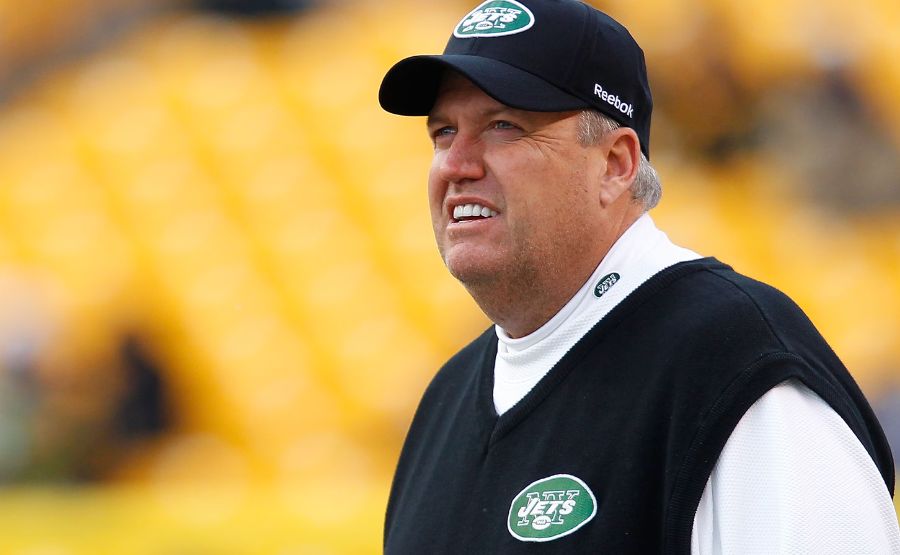
Rex Ryan: The Loudest Man in the Room and What He Revealed About American Football
Rex Ryan still matters because he turned candor into a coaching philosophy, and in doing so exposed how much of professional football runs on theater, fear, and the management of belief.
Quick Facts
| Category | Details |
| Full name | Rex Ashley Ryan |
| Born | December 13, 1962, Ardmore, Oklahoma |
| Nationality | American |
| Parents | Buddy Ryan (NFL head coach) and Doris Ryan |
| Siblings | Older brother Jim Ryan; fraternal twin Rob Ryan, longtime NFL defensive coordinator |
| Education | Southwestern Oklahoma State University, B.A. (1987) |
| Spouse | Michelle Ryan (née Goeringer), married 1987 |
| Children | Two sons, Seth and Payton Ryan |
| Primary roles | NFL head coach (2009–2016); defensive coordinator; NFL analyst, ESPN (2017–present) |
| Head coaching tenures | New York Jets (2009–2014); Buffalo Bills (2015–2016) |
| Career head coaching record | 61–66 regular season; 4–2 in the playoffs |
| Signature achievement | Defensive coordinator, Baltimore Ravens, Super Bowl XXXV champions (2000 season) |
| Other honors | Assistant Coach of the Year, Pro Football Weekly and Pro Football Writers Association (2006) |
| Notable milestone | Back-to-back AFC Championship Game appearances, Jets, 2009 and 2010 seasons |
| Later career | NFL analyst, Sunday NFL Countdown and other ESPN programming, beginning 2017 |
The Inheritance
Rex Ryan was born a coach’s son, and that fact organized everything that followed. His father, Buddy Ryan, built a reputation in Chicago and Philadelphia as a defensive innovator and an unapologetic talker. Rex absorbed both halves of that inheritance: the scheme and the swagger.
He grew up partly in Canada, where Buddy coached in junior hockey-adjacent obscurity before returning to the NFL ranks. The family’s itinerant existence taught Rex something he would carry into his own marriage and coaching life. Football families move. Stability gets built inside the moving, not instead of it.
Rex and his twin brother, Rob, were inseparable as boys and would remain professionally entangled for decades, eventually coaching together on the same staff in Buffalo. Their father’s defensive principles became a kind of family language, passed down rather than studied from a textbook.
See also ”Henry James Zahn: A Portrait of Deliberate Obscurity”
The Long Apprenticeship
Ryan did not arrive in the NFL as a finished product. He spent twenty-two years as an assistant before any team trusted him to lead one, and that apprenticeship is easy to forget given how loudly his head-coaching years would announce themselves.
He played defensive end at Southwestern Oklahoma State University, graduating in 1987. His first coaching job came almost immediately afterward, as a graduate assistant at Eastern Kentucky. From there the map sprawls: New Mexico Highlands in 1988, Morehead State through the early 1990s, then a return to the professional ranks in 1994 as a defensive line and linebackers coach for the Arizona Cardinals, hired by his own father.
That Cardinals staff lasted only two seasons before being dismissed, an early lesson in the profession’s brutal arithmetic, where even a strong defensive unit cannot save a coaching staff attached to a losing record. Ryan moved back to college football, coordinating defenses at Cincinnati and then at the University of Oklahoma, building a reputation as a defensive mind worth watching.
The decisive call came in 1999. Brian Billick, newly named head coach of the Baltimore Ravens, had once sat in on a class Ryan was teaching and never forgot the intensity of it. Billick hired him as a defensive line coach, and Ryan would spend the next decade in Baltimore, rising to defensive coordinator by 2005. The Ravens defense Ryan helped build was central to the team’s Super Bowl XXXV championship and would later be remembered as one of the most dominant units in modern NFL history. In 2006, Ryan was named Assistant Coach of the Year by two separate organizations, confirmation that the league had noticed him.
The Jets Years: Promise and Its Limits
On January 19, 2009, the New York Jets named Rex Ryan their head coach, reportedly on the recommendation of Bill Parcells, who had passed on Ryan for a different job but believed in him enough to point another team his way. Ryan was forty-six years old and had waited his entire adult life for this chance.
He did not wait to make noise. Within his introductory remarks and the season that followed, Ryan predicted his team would win a championship, a statement that drew both mockery and admiration in a league not used to head coaches saying what they actually believed. His first season validated the bravado more than it embarrassed him. The Jets reached the AFC Championship Game, falling one win short of the Super Bowl. The following season, 2010, the team improved to eleven wins and returned to the AFC Championship Game a second time.
No Jets coach has matched that opening act since. The defense Ryan built, an aggressive scheme built around exotic blitz packages and a physical secondary anchored by cornerback Darrelle Revis, gave the team an identity. Television followed the persona: the Jets appeared on HBO’s Hard Knocks in 2010, and Ryan’s unfiltered language drew public criticism from Tony Dungy, the respected former head coach turned commentator. The two men later met privately and made peace, a small but telling detail about how Ryan handled friction. He argued in public and tried to repair things in private.
What followed those two championship-game appearances was four years without a winning season. The quarterback position became the central fracture. Mark Sanchez, the young passer the Jets had bet on, struggled to develop consistently, and Ryan’s late-career Jets teams cycled through backup quarterbacks and offensive coordinators in search of an answer that never arrived. By 2012, general manager Mike Tannenbaum had been fired while Ryan was retained, a sign the organization still believed in him even as the roster around him eroded. It was not enough. After a 4–12 finish in 2014, the Jets fired him.
The number that captures the era best is simple: two trips to the conference championship game in his first two seasons, and a sub-.500 record in the four that followed. Ryan’s tenure in New York is therefore a study in how quickly a promising start can outrun the talent required to sustain it, and how a coach’s force of personality, so effective at lifting a team in year one, can curdle into a question about why the lifting stopped working.
Buffalo and the End of the Sideline
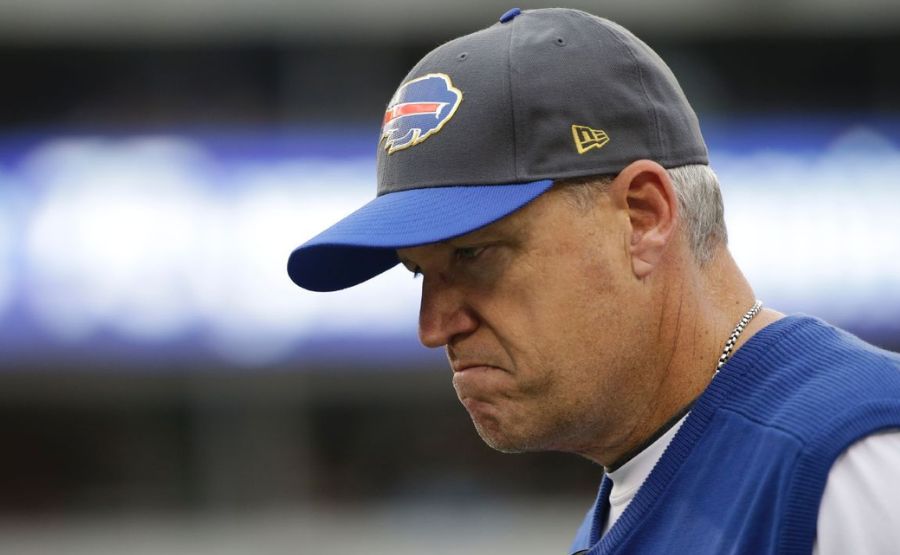
The Bills hired Ryan within weeks of his Jets firing, giving him a five-year contract worth roughly twenty-seven and a half million dollars. The move kept him inside the AFC East, coaching against the team that had just dismissed him twice a year.
Buffalo’s hope was that Ryan’s defensive pedigree and his ability to generate enthusiasm, the hiring reportedly drove a franchise-record wave of season-ticket sales, would finally end a playoff drought that had already stretched well over a decade. It did not. The Bills went 8–8 in 2015 and slipped further in 2016. A leaked team documentary captured Ryan addressing his players with unguarded, profanity-laced honesty about the criticism surrounding him, a moment that revealed both his self-awareness and his inability to change course. He fired his offensive coordinator early in his second season and brought in Anthony Lynn, a move that bought time but not results.
On December 27, 2016, the Bills fired both Rex and his brother Rob, who had been serving as Buffalo’s assistant head coach and defensive coordinator. Ryan called the season’s final defeat one of the most painful losses of his career and admitted, without excuses, to coaching mistakes that contributed to it. His final head-coaching line read 61 wins, 66 losses in the regular season, with a 4–2 playoff record built almost entirely on those first two Jets seasons.
Since then, he has not been an NFL coach.
The Body, the Diet, and the Public Self
Few NFL coaches have made their own physical struggle as visible as Ryan did. By his own account, he weighed around 310 pounds in 2010, after years of diets that failed to hold. That spring, at NYU Medical Center, he underwent lap-band surgery to manage his appetite, a procedure he discussed candidly rather than concealing.
The detail that lingers from that period is a small, almost lonely one: of his players, only quarterback Mark Sanchez checked in on him afterward and visited his home. It is a quiet counterpoint to the image of Ryan as a coach beloved unconditionally by his locker room. Loyalty in professional football, even toward a coach known for fierce loyalty to his players, turns out to be selective and situational, like everywhere else.
Ryan’s weight, his bluntness, and his willingness to be filmed in unscripted moments made him an unusually exposed public figure for a head coach. Most coaches manage their image; Ryan largely let his happen in front of cameras, for better and for worse.
Personal Life and the Private Architecture Behind the Noise
Ryan met Michelle Goeringer while both were students at Southwestern Oklahoma State University in the early 1980s. She was preparing for a teaching career; he was a defensive end with no NFL credentials yet to his name. They married in 1987, the same year he graduated and took his first coaching job, a pairing of milestones that set the pattern for the rest of their life together: each career step for Rex arriving alongside a corresponding adjustment for the family.
The Ryans had two sons, Seth, born in 1994, and Payton. Seth followed his father into the coaching profession, working his way into assistant roles at the college and NFL level. Payton has kept a lower public profile. Michelle herself has rarely spoken publicly and has not published an account of her own experience, which means most of what is known about the marriage comes through the secondhand lens of sportswriters covering Rex rather than through her own words.
What can be said with confidence is narrower than many recent online profiles claim. The family moved repeatedly as Rex’s career carried them from college towns to Baltimore to the New York metropolitan area to Buffalo. During the Jets years, the family developed game-day routines, including a preference for a specific restaurant on Friday nights and clothing tied to team colors, the sort of small ritual common among families embedded in a high-pressure, superstition-prone sport. Rex’s father, Buddy Ryan, was diagnosed with cancer in the early 2010s, and the family’s attention to his illness in his final years offered a glimpse of a more private, less performative side of a famously performative household. Buddy Ryan died in 2016.
Claims that have circulated about Michelle’s later career, including specific job titles or business ventures, are not reliably documented and should be treated with caution rather than repeated as settled fact. The more durable, well-supported picture is simpler: a marriage that began before fame arrived, survived repeated relocation, and weathered the particular strain of a husband whose failures and successes both played out on national television.
The Television Second Act
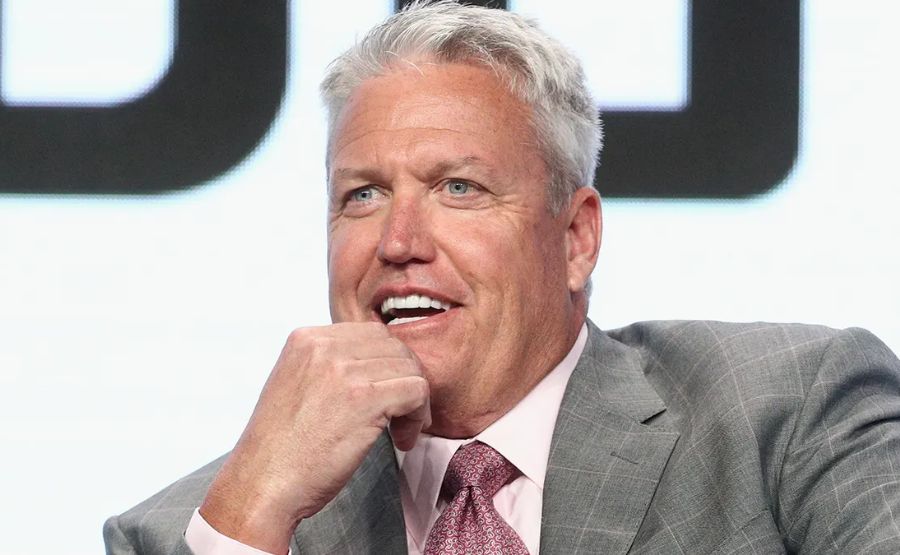
ESPN hired Ryan as an analyst in April 2017, four months after Buffalo let him go. The transition suited him in ways coaching sometimes had not. Television rewards the very qualities that made him a complicated head coach, directness, humor, an apparent inability to filter himself, without requiring him to manage a quarterback room or a salary cap.
On Sunday NFL Countdown and various other ESPN platforms, Ryan has built a second career as one of the league’s more recognizable media voices, trading the pressure of Sunday outcomes for the lower-stakes performance of Sunday commentary. It is a career many former coaches attempt and few inhabit as naturally. Ryan’s twenty-two years of waiting to become a head coach, followed by eight years of swinging between brilliance and collapse, gave him an unusually wide well of stories and opinions to draw from in front of a camera.
Legacy and Why He Still Resonates
Rex Ryan’s lasting significance has less to do with his win total, modest by Hall of Fame standards, and more to do with what his career exposed about the modern NFL’s relationship to personality. He proved that a coach could speak in absolutes, guarantee championships, curse on camera, and survive all of it as long as the early results backed up the noise. He also proved the reverse: that once results stop backing up the noise, the same bravado that made him compelling becomes the first thing pointed to in his obituary as a coach.
His coaching tree carries real weight. Mike Pettine, Brian Schottenheimer, and Anthony Lynn all became NFL head coaches after working under Ryan, suggesting that whatever frustrated front offices about his own results, the system and the staff-building underneath him produced coaches other organizations wanted to hire. His defensive principles, the unpredictable blitz packages, the trust placed in physical, press-coverage cornerbacks, remain visible in modern defensive design even among coaches who never worked for him directly.
There is also a more cultural legacy. Ryan’s two seasons of Hard Knocks exposure helped normalize a kind of unscripted access to NFL locker rooms that networks and leagues now treat as standard programming rather than a risky experiment. His comfort with surgery, weight loss, and public vulnerability around his body predated a broader, slower shift in how male professional athletes and coaches talk about health.
Final Words
Rex Ryan’s career resists a tidy verdict, and that resistance is itself the most honest thing that can be said about him. He inherited a coaching mind from his father and built on it skillfully enough to help author one of the better defenses in Super Bowl history. He then spent eight years as a head coach proving that the same self-belief which can lift a roster to consecutive conference championship games can also blind a coach to a roster’s deeper, unsolved problems.
He was, by most credible accounts, generously loyal to players and staff, unusually transparent about his own body and his own doubts, and incapable of the kind of guarded self-management that keeps many coaches employed past the point their results justify it. None of those traits cancel the others out. They sat inside the same man, often in the same press conference.
What endures is less a record than a tone: the sense, rare in a profession built on caution, that a person was telling you what he actually thought. Football is now, decades later, a league more comfortable with personality-driven coaches and unscripted television than it was when Ryan first guaranteed a championship in 2009. He did not cause that shift by himself. But he was one of the people standing loudest in the room when it began.
FAQs
1. Who is Rex Ryan?
Rex Ashley Ryan is an American former NFL head coach, best known for leading the New York Jets (2009–2014) and Buffalo Bills (2015–2016), and now an NFL analyst for ESPN.
2. When and where was Rex Ryan born?
He was born December 13, 1962, in Ardmore, Oklahoma.
3. Is Rex Ryan related to other NFL coaches?
Yes. His father, Buddy Ryan, was a longtime NFL head coach and defensive innovator. His fraternal twin brother, Rob Ryan, is also a longtime NFL defensive coordinator.
4. What is Rex Ryan’s career head-coaching record?
He finished with a 61–66 regular-season record and a 4–2 playoff record across eight seasons.
5. What was Rex Ryan’s biggest coaching achievement?
As defensive coordinator of the Baltimore Ravens, he helped build the defense that won Super Bowl XXXV following the 2000 season.
6. Did Rex Ryan ever reach a Super Bowl as a head coach?
No. His Jets teams reached back-to-back AFC Championship Games in 2009 and 2010 but lost both, falling short of a Super Bowl appearance.
7. Why was Rex Ryan fired by the Jets?
After four consecutive non-winning seasons following his initial success, the Jets fired him following a 4–12 finish in 2014.
8. Why was Rex Ryan fired by the Bills?
Buffalo dismissed him on December 27, 2016, after he failed to end the franchise’s long playoff drought and reportedly lost the support of parts of his locker room.
9. Who is Rex Ryan’s wife?
Michelle Ryan, née Goeringer, whom he married in 1987 after meeting her at Southwestern Oklahoma State University.
10. Does Rex Ryan have children?
He has two sons, Seth and Payton Ryan. Seth followed his father into football coaching.
11. What did Rex Ryan do after his NFL coaching career ended?
He joined ESPN as an NFL analyst in 2017 and continues to appear on programs such as Sunday NFL Countdown.
12. What is Rex Ryan best known for as a personality?
His outspoken, unfiltered public style, including bold predictions, his appearances on HBO’s Hard Knocks, and his public candor about his own weight-loss surgery.
13. Did Rex Ryan coach with his brother?
Yes. Rob Ryan served on Rex’s coaching staff in Buffalo as assistant head coach and defensive coordinator before both were dismissed together in December 2016.
14. Which coaches got their start under Rex Ryan?
Mike Pettine, Brian Schottenheimer, and Anthony Lynn all later became NFL head coaches after working on Ryan’s staffs.
15. Is Rex Ryan still involved in football today?
He is not currently coaching but remains active in football media as an ESPN analyst.
Learn, explore, and grow with every article you read at Context House.